





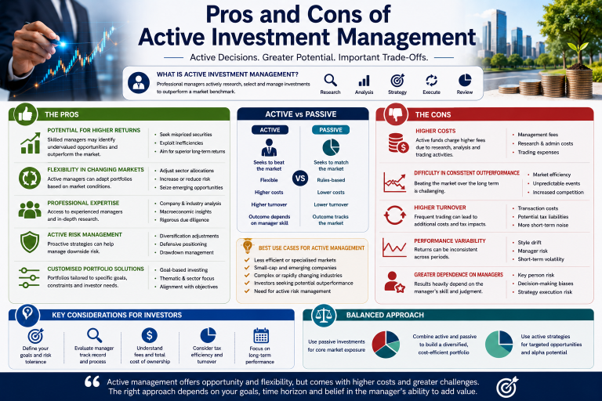
Investing is one of the most effective ways to build wealth over time, but investors have different approaches when it comes to managing their portfolios. One of the most widely discussed methods is active investment management, where professional portfolio managers make investment decisions with the goal of outperforming a specific market benchmark or index. An […]
Investing is one of the most effective ways to build wealth over time, but investors have different approaches when it comes to managing their portfolios. One of the most widely discussed methods is active investment management, where professional portfolio managers make investment decisions with the goal of outperforming a specific market benchmark or index.
An activist investor represents one specialised form of active management, where investors take significant positions in companies and seek to influence corporate decisions to unlock shareholder value. While not all active managers take this approach, it highlights the broad range of strategies that fall under active investing.
Another variation is the activist investment strategy, which focuses on identifying opportunities for operational improvements, governance changes, or capital allocation enhancements within companies. These approaches demonstrate how active management extends beyond simply selecting stocks and can involve direct engagement with businesses.
What Is Active Investment Management?
Active investment management involves the ongoing selection, buying, and selling of securities by professional fund managers or investment teams.
Unlike passive investing, which aims to replicate the performance of a market index, active managers attempt to outperform the market through research, analysis, and strategic decision-making.
Active managers may evaluate factors such as:
- Company fundamentals
- Industry trends
- Economic conditions
- Valuation metrics
- Competitive advantages
- Management quality
The goal is to identify investments that offer attractive risk-adjusted return potential while avoiding securities that appear overvalued or vulnerable.
This hands-on approach requires continuous monitoring and frequent adjustments as market conditions evolve.
The Potential Advantages of Active Management
One of the primary reasons investors choose active management is the possibility of achieving superior returns.
Experienced managers can potentially identify undervalued opportunities before they become widely recognised by the broader market.
Potential advantages include:
- Opportunity to outperform market benchmarks
- Flexibility in changing market conditions
- Professional research and analysis
- Customised portfolio positioning
- Active risk management
Because active managers are not restricted to mirroring an index, they can adjust portfolio allocations based on changing economic environments or emerging opportunities.
For investors seeking a more dynamic investment approach, this flexibility can be particularly appealing.
Flexibility During Market Volatility
Market conditions can change rapidly, especially during periods of economic uncertainty. One advantage of active management is the ability to respond proactively to these changes.
During volatile markets, active managers may:
- Reduce exposure to high-risk sectors
- Increase defensive positions
- Hold higher cash allocations
- Rebalance portfolios strategically
- Take advantage of market dislocations
This flexibility can help manage downside risk during challenging market environments.
For example, during periods of economic stress, an active manager may shift investments toward sectors considered more resilient, such as healthcare or consumer staples.
Passive strategies, by contrast, generally remain fully invested according to index composition regardless of market conditions.
Access to Specialised Expertise
Active management often provides investors with access to highly experienced investment professionals and research teams.
These teams may conduct extensive analysis, including:
- Company meetings
- Industry research
- Financial modeling
- Competitive assessments
- Macroeconomic analysis
This depth of research can uncover opportunities that individual investors may not have the resources or expertise to identify independently.
Professional oversight can be particularly valuable in complex or specialised markets where detailed knowledge is essential.
Examples include:
- Emerging markets
- Small-cap equities
- Sector-specific investments
- Alternative asset classes
In such areas, active expertise may provide a meaningful advantage.
The Drawback of Higher Costs
One of the most frequently cited disadvantages of active management is cost.
Active funds typically charge higher management fees than passive investment products because of the resources required for research, analysis, and portfolio management.
These costs may include:
- Management fees
- Research expenses
- Trading costs
- Administrative expenses
Higher fees can reduce net returns over time, particularly if a fund fails to consistently outperform its benchmark.
Even small differences in annual fees can have a significant impact on long-term investment outcomes due to the effects of compounding.
Investors should carefully evaluate whether the potential benefits justify the additional costs.
The Challenge of Consistent Outperformance
While active management offers the possibility of outperforming the market, achieving consistent success is difficult.
Financial markets are highly competitive, and thousands of professional investors analyse the same information every day.
As a result, identifying mispriced opportunities is often challenging.
Some active managers outperform during certain periods but struggle to maintain that performance over longer time horizons.
Several factors contribute to this challenge:
- Market efficiency
- Unpredictable economic events
- Behavioral biases
- Changing market conditions
- Increased competition
Numerous studies have shown that many actively managed funds underperform their benchmarks after accounting for fees and expenses.
This reality highlights the importance of manager selection when considering active strategies.
Increased Portfolio Turnover
Active management generally involves more frequent buying and selling of securities.
Higher portfolio turnover can create several potential drawbacks:
- Increased transaction costs
- Greater tax implications
- Higher operational complexity
- Increased sensitivity to short-term market movements
Frequent trading may generate taxable gains for investors in taxable accounts, potentially reducing after-tax returns.
Additionally, excessive trading can sometimes reflect attempts to time the market, which may not always lead to better outcomes.
Investors should understand a manager’s investment philosophy and turnover strategy before committing capital.
When Active Management May Be Most Appropriate
Active management is not inherently better or worse than passive investing. Its suitability depends on an investor’s objectives, preferences, and circumstances.
Active management may be appropriate for investors who:
- Seek the potential for market outperformance
- Value professional oversight
- Desire risk-management flexibility
- Invest in less efficient markets
- Prefer a more hands-on investment approach
Certain market segments may offer greater opportunities for active managers to add value, particularly where information is less widely available or where company analysis is more complex.
However, investors should maintain realistic expectations regarding performance and recognise that higher returns are not guaranteed.
Balancing Active and Passive Approaches
Many investors choose to combine active and passive strategies within a single portfolio.
This blended approach allows them to benefit from:
- Broad market exposure through passive investments
- Specialised opportunities through active management
- Cost efficiency
- Diversification
- Flexible risk management
For example, an investor might use low-cost index funds as a core portfolio allocation while allocating a smaller portion to actively managed strategies focused on specific sectors or regions.
This approach seeks to balance potential alpha generation with cost control and diversification.
The appropriate allocation depends on individual investment goals, risk tolerance, and time horizon.
Conclusion
Active investment management offers several potential advantages, including professional expertise, flexibility, risk management, and the possibility of outperforming market benchmarks. Skilled managers can identify opportunities, adapt to changing market conditions, and provide strategic oversight that may add value for investors.
However, active management also comes with important challenges. Higher fees, increased turnover, tax implications, and the difficulty of consistently outperforming the market are factors that should not be overlooked.
Ultimately, the decision between active and passive investing is not necessarily an either-or choice. Many investors benefit from combining both approaches to create a diversified and balanced portfolio.